
Plates#
Microplates are modelled by the Plate class consisting of equally spaced wells. Wells are children of the Plate and are modelled by the Well class. The relative positioning of a Well is what determines its location. Plate is a subclass of ItemizedResource, allowing convenient integer and string indexing.
There is some standardization on plate dimensions by SLAS, which you can read more about in the ANSI SLAS 1-2004 (R2012): Footprint Dimensions doc. Note that PLR fully supports all plate dimensions, sizes, relative well spacings, etc.
Special Plate Tutorials#
Plate#
PLR is not actively enforcing a specific plate naming standard but recommends the following:
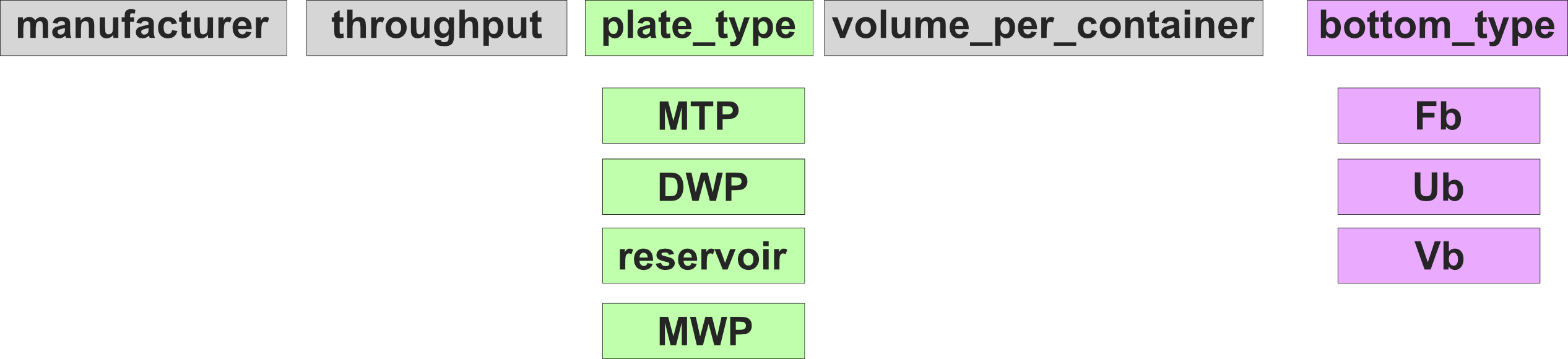
This standard is similar to the Opentrons API labware naming standard but:
Further sub-categorizes “wellplates” to facilitate communication with day-to-day users, and
Adds information about the well-bottom geometry.
(WIP)
Lids#
Plates can optionally have a lid, which will also be a child of the Plate class. The lid is modelled by the Lid class.
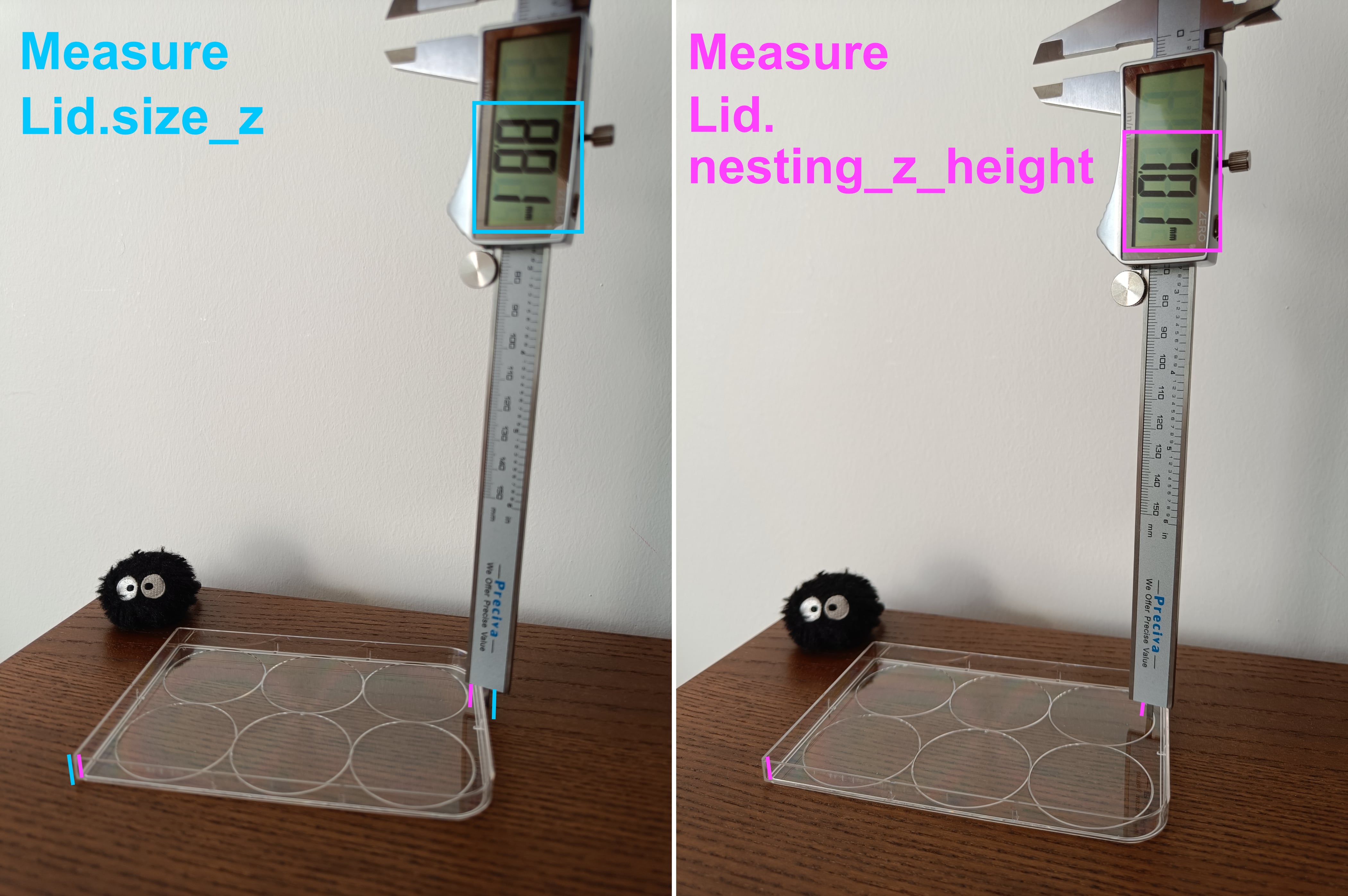
Measuring nesting_z_height#
The nesting_z_height is the overlap between the lid and the plate when the lid is placed on the plate. This property can be measured using a caliper.
stacking_z_height#
Plate accepts an optional stacking_z_height argument: the vertical pitch (in mm) that one plate adds to a stack when an identical plate is placed directly on top of it. Equivalently, it is size_z minus the amount two identical plates nest into one another.
It defaults to None (unknown) and is only required by devices that physically stack plates, such as the Agilent BenchCel microplate handler. It mirrors the stacking_z_height of a nested tip rack (StandingTipRack).
To measure it, stack two identical plates and measure the total height with a caliper; then:
stacking_z_height = height_of_two_stacked_plates - size_z
More generally, a stack of N identical plates is size_z + (N - 1) * stacking_z_height tall.
When set, ResourceStack uses this value so that bare plates stacked in the z direction nest into one another (a plate placed on another bare plate sinks in by size_z - stacking_z_height). Plates without a stacking_z_height, and plates wearing a lid, do not nest.
Because stacking_z_height is a physical dimension, two plates that differ in it are treated as different labware and do not compare equal.